Back to work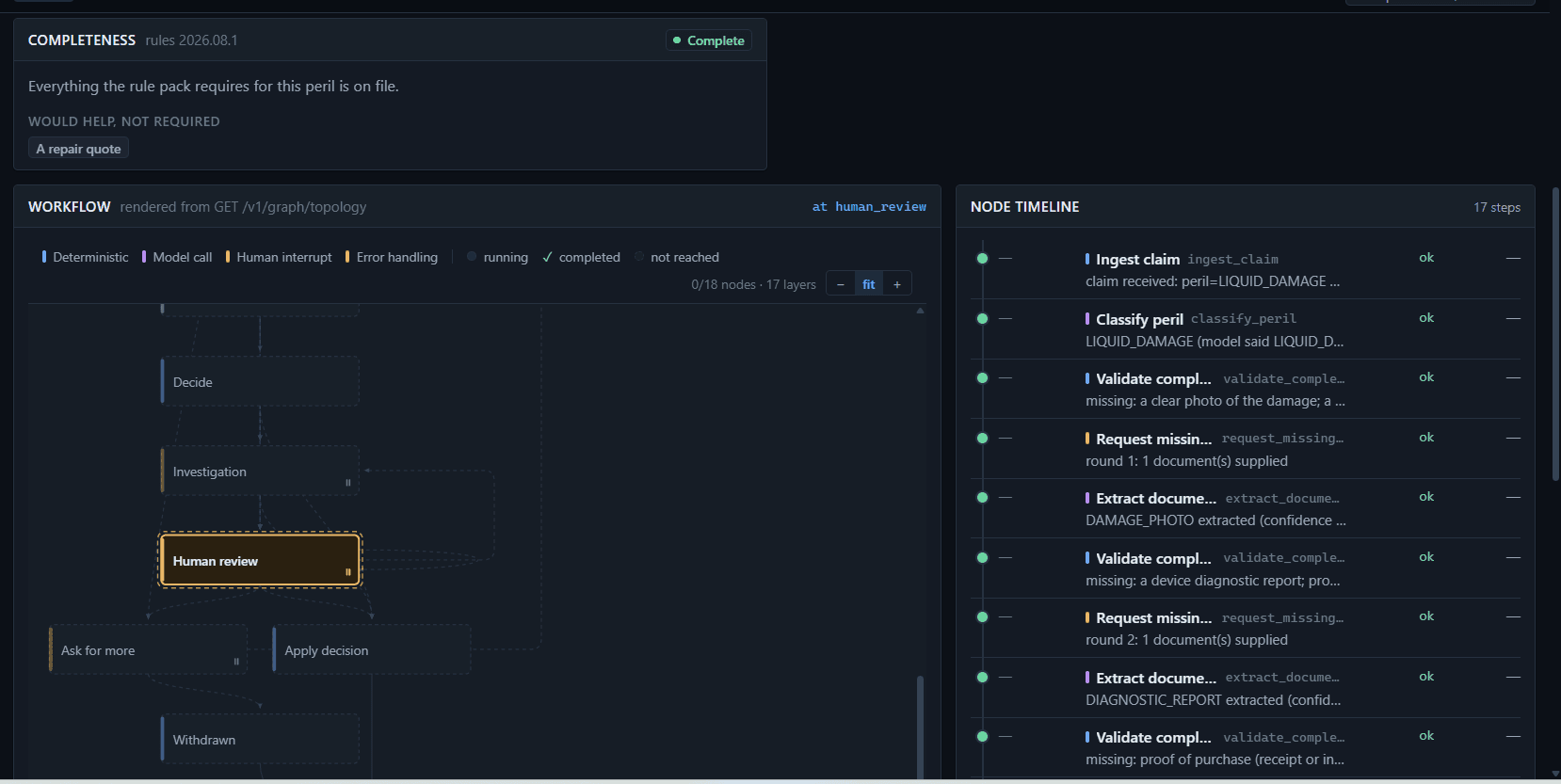
Confidentiality note: The workflow image shows development demonstration states. Customer documents, claimant records, AWS account identifiers, credentials, and internal endpoints are not included in this case study.
Personal project | AI + insurance claims
Claims Assessment Platform
An AI-assisted insurance claims platform that turns document intake, policy checks, and model assessments into durable, auditable workflows with explicit human decision authority.
Durable human review3 AWS services verifiedDeterministic approval rules
Problem
Insurance assessment combines incomplete documents, policy eligibility, ambiguous evidence, and financial authority. A useful AI workflow must coordinate these steps while keeping decisions explainable and accountable to an authorized reviewer.
Approach
- Implemented LangGraph orchestration with typed state, parallel document extraction, conditional routing, bounded retries, and missing-information loops.
- Separated Bedrock classification, extraction, and assessment from pure domain rules that determine eligibility, approval limits, and review requirements.
- Made human review durable through PostgreSQL checkpoints, allowing a claim to pause and resume after the graph and connection pool are reconstructed.
Architecture
- A Next.js claims console routes requests through a backend-for-frontend layer with HttpOnly authentication cookies.
- FastAPI validates access, persists claims, issues direct S3 document uploads, and queues work through SQS FIFO.
- An independent LangGraph worker invokes Amazon Bedrock and checkpoints workflow state in PostgreSQL; per-claim message groups serialize queued work.
- Terraform defines ECS Fargate services, RDS, S3, SQS, KMS, private networking, and CloudWatch monitoring; GitHub Actions handles validation and deployment.
Production
- Automatic approval requires deterministic checks to pass; decline is reachable only through an authorized human verdict.
- Reviewer role and monetary authority are checked at both the API boundary and the decision node.
- Hash-chained audit events preserve actor attribution, while structured logs and workflow timelines expose execution and failure states.
- Captured deployment evidence records three running ECS services and a Terraform plan with no infrastructure changes.
Tradeoffs + next steps
- This is a personally built assessment implementation verified in AWS dev, rather than a customer production rollout. The dev environment is brought up on demand; production infrastructure is defined but not applied.
- Policy administration uses a typed adapter; production work would include integrating a real policy system, document malware scanning, and shared persistence for idempotency and upload reservations.
- Unreadable PDFs request a replacement document instead of allowing uncertain extraction to silently reach a decision.
Result
Delivered a reproducible claims workflow covering intake, evidence extraction, policy checks, AI assessment, approval, investigation, and durable human review, with AWS deployment evidence and documented engineering decisions.
Stack
Next case study
Data Project AnalyzerDiscuss production AI
Email Fazeel